

By Anna Clarke
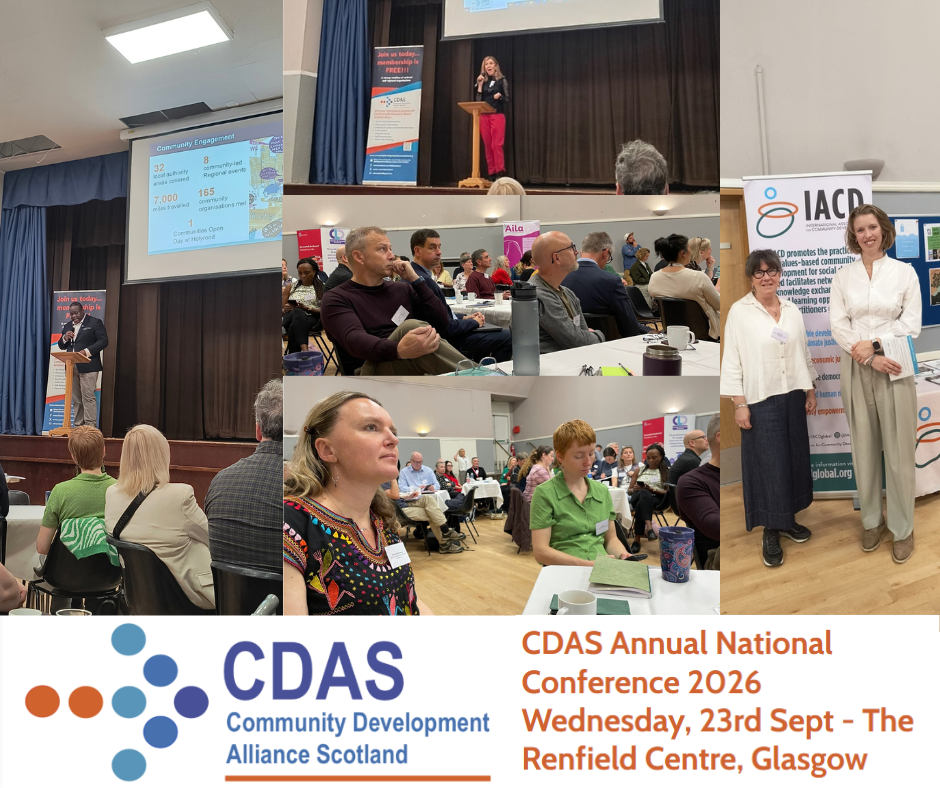
Returning to Glasgow so soon after the World Community Development Conference in June felt like a natural continuation of an urgent global conversation. At WCDC2026, practitioners, activists, educators, researchers, and students gathered to debate how community development responds to a chaotic world. At the Community Development Alliance Scotland conference (23rd September), that international momentum was brought into direct dialogue with national policy and practice, and it prompted me to consider from an IACD perspective: what does this look like elsewhere?
As Strategic Director with IACD, I was delighted to sit on the panel discussion examining Community Development: our role in influencing decisions which affect quality learning & education. The rich debates within our panel sessions offered a clear line of sight between global standards, supporting a professionally qualified workforce, national legislative ambitions, and impactful community development practice.
Power, Trust, and Reform
Susan Paxton, Director of the Scottish Community Development Centre re-anchored the conference in a fundamental truth: community development is explicitly rooted in social justice, dedicated to decentralising power so communities gain genuine control over decisions and resources.
As Scotland prepares for significant public sector reforms, Susan noted government ambition was higher than anticipated. Again, I found myself wondering: what does this look like elsewhere? Is it better, worse, or just different?
Susan posed critical caveats around power, trust, and accountability:
• Meaningful Reform vs. Structural Distraction: Will reforms deliver real empowerment, or divert energy into maintaining administrative structures?
• Communicating the 'Why': People need to see tangible benefits that can be shaped, seen, and felt in daily life.
• A Level Playing Field: Poverty reduction requires equity. What will shifts mean for the poorest communities and frontline workers?
• Subsidiarity in Action: If democracy really matters, what specific powers will communities have to make local decision-making real?
Autonomy, Safeguards, and Radical Imagination
Minister for Public Finance Hannah Mary Goodlad highlighted Community Empowerment and Community Wealth Building as priority areas. Pointing to Shetland’s historic Zetland County Council Act 1974 - where oil wealth and seabed rights were secured for the people, revenues continue to support island services. I wondered what other examples exist elsewhere? What community development processes were involved, and to what extent were community development values reflected in these decisions?
Reflecting on Scotland’s landmark 2026 Community Wealth Building Act, the Minister stressed creating safeguards for the next 60 years. Where else is talking about ‘community’ and ‘safeguards for the next 60 years’ in the same sentence? Pointing to Nordic governance models (like Norway's 350+ community councils), she highlighted how structures operate elsewhere to push decision-making closer to communities. She argued that confronting social division, rising racism, violence against women and girls and the far right requires democracy driven from within communities, not built from ivory towers.
Chi Kavindele, Head of the Participation and Communities Team at the Scottish Parliament, reminded participants: ‘What later feels normal often begins as radical,’ calling for radical ambition, including reclassifying lived experience as ‘legitimate evidence’ in parliamentary decision-making.
Sitting on the Panel alongside colleagues from Education Scotland, the CLD Standards Council, and CLD Managers Scotland, our connection to the keynotes was clear: you cannot decentralise decision-making or execute Community Wealth Building without resourcing the workforce that facilitates community development.
In the panel discussions we addressed four core questions:
1. AI & Critical Digital Pedagogy: Grounded in values of social justice, education, training and practice needs to focus on critical digital literacy to critique misinformation, disinformation, algorithmic bias and protect data sovereignty.
2. Overcoming Sector Fragmentation: Workforce precarity is the real threat. Practitioners need recognised qualification pathways, fair pay, professional endorsement and parity of recognition, regardless of where they are employed.
3. Sustaining Infrastructure: building and embedding genuine democratic participation and community empowerment requires statutory, multi-year policy commitments to core-fund community development infrastructure.
4. A Democratic Workforce: Community development practitioners need to be recognised as the frontline democratic workforce facilitating participatory processes and holding power accountable.
The International Standards for Community Development Practice remind us that supporting learning for change, building community leadership, and confronting inequality are global imperatives. Maintaining high-quality education and training standards ensures practitioners have the skills to navigate complex landscapes.
If nationally or globally we want to see high (equitable, fair and socially just) political ambitions turned into meaningful realities for those communities most disadvantaged, government policies must invest directly in the professional standards, infrastructure, and practitioners who do the quiet, transformative work of supporting communities to build power from the ground up.
Yet we know that this picture looks vastly different around the world. Drawing on the discussions in Glasgow, and the questions raised, I want to invite you to share what 'the picture' looks like in your own national or regional context:
• Where do you see strategic policy support for community development—or policy frameworks that clearly embody community development purposes, values, and processes, even if that explicit language is not used?
• How does policy in your country/region recognise the right of communities to be central to democratic decision-making processes, and what structures and mechanisms are in place that genuinely facilitate and enable this?
• What models of collaborative cross-sectoral working between the state/public sector and the community sector/civil society organisations are actually seen and felt to be effective in benefiting those communities most disadvantaged in your country? And how are community/civil society organisations influencing and shaping this?
Pulling these questions together across our global practice is vital if we are to learn from one another, challenge assumptions, and strengthen our collective focus. Please share your reflections, local contexts, and examples with us at IACD - we want to hear your voice as we move forward with this international dialogue.